
In conversation with Sarah Cummings: Survey Instructor, Royal School of Military Engineering
How did your interest in surveying as a career develop?
I’ve always had a strong interest in geography and a love for the outdoors. At the time, my only exposure to surveying was through roles like quantity surveying and condition surveys, which I knew of through my brother, who was an architect. It wasn’t until I began working at IETG, now part of SOCOTEC UK, as a Workshop Technician that I discovered land and utility surveying thanks to 40SEVEN, a sister company. When a Trainee Surveyor position became available, I saw the perfect opportunity to combine my passion for hands-on work, being outdoors and learning new skills. I applied and from that moment on, I was hooked! Land and utility surveying has become a true career path for me, and I’ve never looked back.
What is a key memory from your time spent studying at The Survey School?
I really valued learning the theory behind the practical work I was doing day-to-day. Gaining a deeper understanding of the “how” and “why” behind surveying significantly improved my skills and made me a more effective surveyor. As a kinesthetic learner, hands on experiences are how I learn best, and school played a crucial role in supporting that. It not only strengthened my knowledge but deepened my passion for the profession. I’m genuinely grateful to The Survey School, Andrew Crumpler, and everyone else who supported me throughout my journey
What was the most valuable lesson you learned from your time at The Survey School?
Check, Check and check again! It’s always better to do more and have the choice to use and or delete what you don’t need.
What is it about your current role at The Royal School of Military Engineering that you enjoy and value most?
I currently work as a Survey Instructor for Mid-Kent College at 1 RSME, and I feel privileged to be in a role where I can help shape the next generation of surveyors and soldiers. It’s incredibly rewarding to pass on knowledge and experience and to see trainees develop into capable surveyors. I deliver training that equips them with the skills to operate in both civilian and military environments, using a range of equipment from levels to S5 Total Stations and the X9 Scanner. We focus not only on technical proficiency but also the importance of accuracy, data processing, and producing clear, reliable drawings that meet operational demands anywhere in the world.
How would you describe your career in three words?
Technically 4 words (3 is so hard!) : Blessed, Life Changing, Team, Learning
How do you encourage others to get involved in the surveying profession?
I’m genuinely passionate about it, it’s given me the opportunity to explore a wide range of experiences and roles. In previous and current roles, I actively supported and help train trainees and staff, sharing both technical knowledge and on the job insight. Whenever someone asks about my work, I’m always eager to talk about surveying and highlight how it’s connected to so many aspects of everyday life. I try to relate it to familiar objects or tasks to help people see just how relevant and impactful the profession is.
I particularly want younger people to have access to the same opportunities I’ve had. The Survey Association course played a huge role in shaping my understanding of how and why surveying works. I believe it’s a vital foundation for anyone entering the field combining solid theoretical knowledge with practical experience to develop well-rounded, capable surveyors.
If you could give your younger self career advice now, what would it be?
Be open to every opportunity. Too often, we say “no” out of hesitation or fear and miss out on experiences that could lead to growth. It’s far better to try and stumble than to never try at all. You learn more from taking a chance than from standing still.
Do you have any exciting projects you’re working on at MKC Training that you’re able to share?
I am currently involved in updating and enhancing the Hydrographic phase of the course. As part of this effort, we are collaborating with the Royal Navy. Recently, RN personnel joined us on the Tactical Support Boat (CSB) on the River Medway, where they observed our training exercises using the Total Station, GNSS, and the SonarMite system. In Trimble Business Center (TBC), we demonstrated how the hydrographic data could be integrated into a topographical model to create a more comprehensive survey output. Looking ahead, we are planning further engagement with other branches and specialisations, including a visit to Devonport to connect with the Hydrographic Exploitation Group (HXG).
What has been your most memorable project to work on?
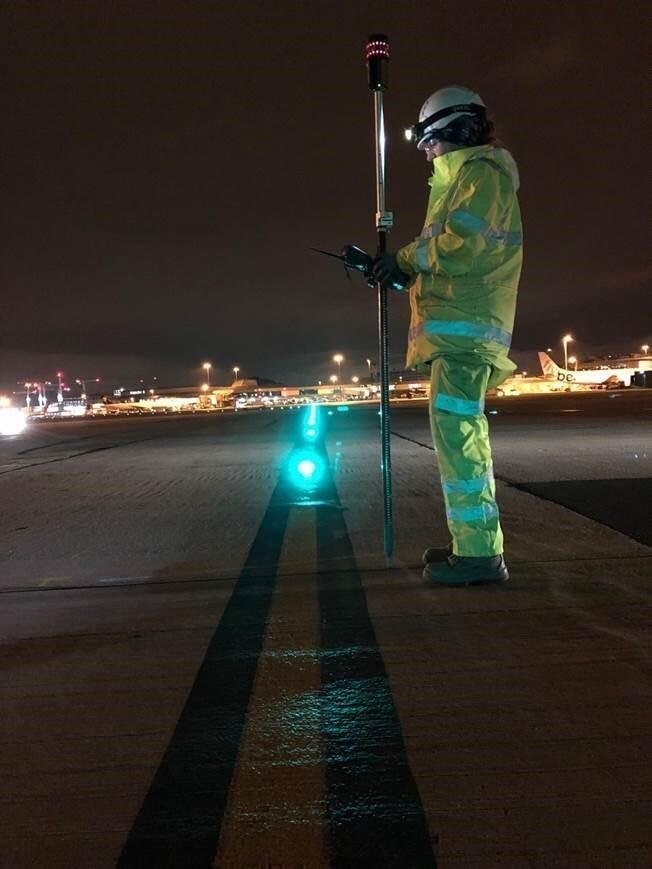
I worked on the Manchester Airport expansion project, which required a comprehensive topographical and utility survey covering both landside and airside areas including the taxiways. Working airside brought a unique sense of privilege and responsibility. The project demanded close coordination and planning between our survey team, the main contractor, ground control, and various subcontractors. It was a complex and fast-paced environment that constantly challenged me to adapt and find solutions under pressure. Now that the project is complete, I feel a strong sense of pride every time I visit the airport. I often find myself thinking, “I surveyed that.” Revisiting past project sites always brings back valuable memories and reinforces the professional growth I’ve gained through those experiences.
What has been your proudest career moment?
I can’t pick just one! Being part of The Survey Department Team at 1 RSME. Picking up the Institution Medal by the Chartered Institution of Civil Engineering Surveyors (CICES) – and passing the TSA Course!